***** Introduction *****
Diffrentiation (Derivatives)
Diffrentiation (Derivatives)
The derivative of a function of a real variable measures the sensitivity to change of a quantity (a function value or dependent variable) which is determined by another quantity (the independent variable). Derivatives are a fundamental tool of calculus. For example, the derivative of the position of a moving object with respect to time is the object's velocity: this measures how quickly the position of the object changes when time is advanced.
The derivative of a function of a single variable at a chosen input value is the slope of the tangent line to the graph of the function at that point. This means that it describes the best linear approximation of the function near that input value. For this reason, the derivative is often described as the "instantaneous rate of change", the ratio of the instantaneous change in the dependent variable to that of the independent variable.
The simplest case, apart from the trivial case of a constant function, is when y is a linear function of x, meaning that the graph of y divided by x is a line. In this case,y = f(x) = m x + b, for real numbers m and b, and the slope m is given by

- Two distinct notations are commonly used for the derivative, one deriving from Leibniz and the other from Joseph Louis Lagrange.
- In Leibniz's notation, an infinitesimal change in x is denoted by dx, and the derivative of y with respect to x is written


- This expression is Newton's difference quotient. Passing from an approximation to an exact answer is done using a limit. Geometrically, the limit of the secant lines is the tangent line. Therefore, the limit of the difference quotient as h approaches zero, if it exists, should represent the slope of the tangent line to (a, f(a)). This limit is defined to be the derivative of the function f at a:

- Integration
- The integral is an important concept in mathematics. Integration is one of the two main operations in calculus, with its inverse, differentiation, being the other. Given a function f of a real variable x and an interval [a, b] of the real line, thedefinite integral
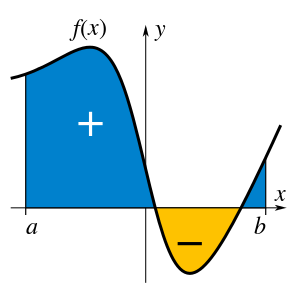
- The major advance in integration came in the 17th century with the independent discovery of the fundamental theorem of calculus by Newton and Leibniz. The theorem demonstrates a connection between integration and differentiation. This connection, combined with the comparative ease of differentiation, can be exploited to calculate integrals. In particular, the fundamental theorem of calculus allows one to solve a much broader class of problems. Equal in importance is the comprehensive mathematical framework that both Newton and Leibniz developed. Given the name infinitesimal calculus, it allowed for precise analysis of functions within continuous domains. This framework eventually became modern calculus, whose notation for integrals is drawn directly from the work of Leibniz.
- Thank You
- Asit Joshi


No comments:
Post a Comment